

Introduction
Excessive frost buildup is a common issue in industrial food freezing equipment. When frost accumulates too quickly on evaporator surfaces, it gradually blocks the air passages between fins, restricting airflow and reducing heat transfer efficiency. This can result in longer freezing times, increased energy consumption, and more frequent production interruptions.
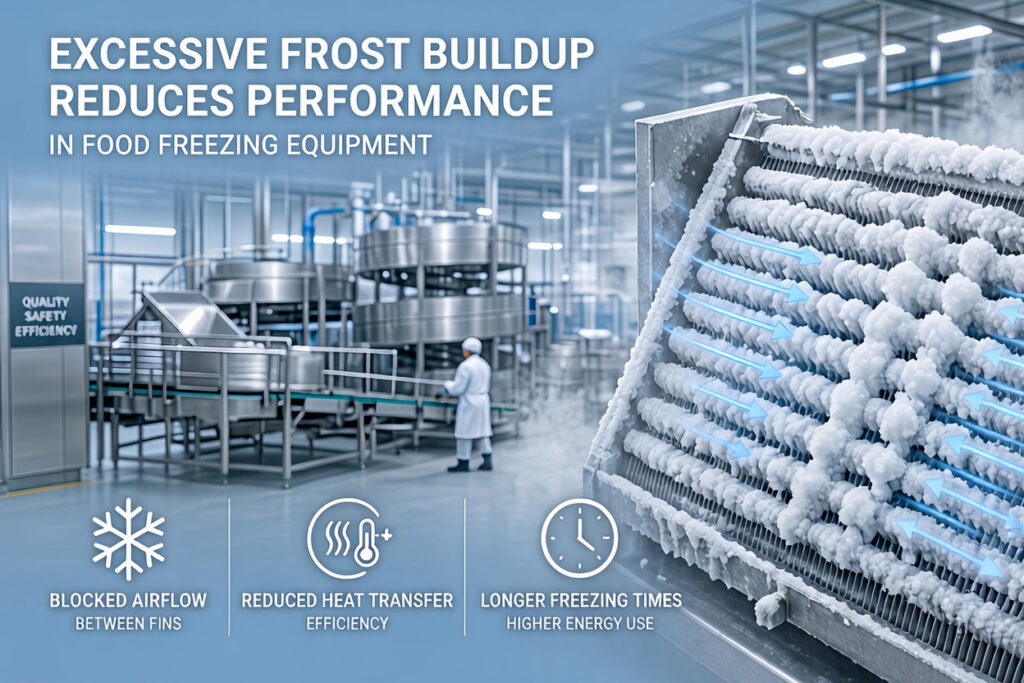
For food processing plants operating spiral freezers, tunnel freezers, and other continuous freezing systems, these problems not only affect equipment performance but can also reduce actual production capacity and increase operating costs.
However, frequent frost buildup does not necessarily indicate equipment failure. It may also reflect excessive moisture entering the system, unsuitable evaporator design, changing operating conditions, or an inefficient defrost control strategy.
Therefore, addressing excessive frost buildup starts with identifying its underlying causes and implementing solutions based on the equipment configuration and actual production requirements.
1. Why Do Industrial Freezers Frost Up So Quickly?
Frost forms when water vapor in the air comes into contact with evaporator surfaces below freezing temperature. The moisture condenses and gradually freezes, accumulating on the evaporator tubes and fins.
Some frost formation is normal in low-temperature food freezing applications. However, when frost accumulates faster than the system can effectively manage, it can interfere with normal equipment operation. The most common causes include the following.
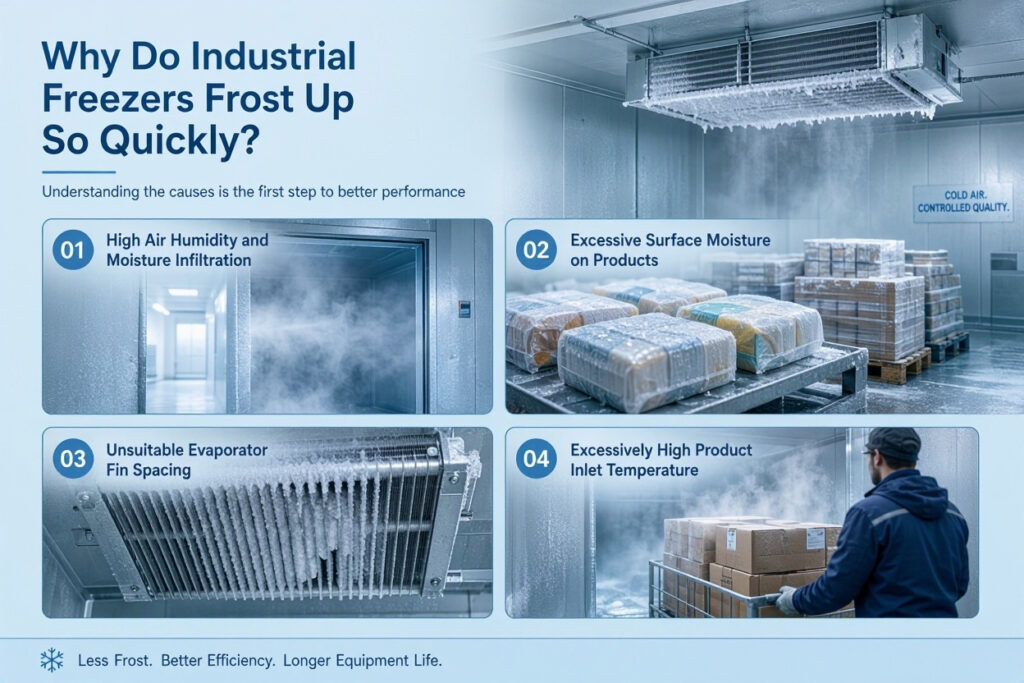
1.1 High Air Humidity and Moisture Infiltration
The entry of humid air into the freezing chamber is one of the major causes of rapid evaporator frosting.
Common sources of moisture include:
- Frequently opened equipment entrances and exits during production.
- Poor sealing around freezer inlets and discharge openings.
- High-humidity air from upstream processing areas.
- Moisture carried into the freezer by incoming products.
When warm, humid air enters a low-temperature freezing environment, water vapor condenses and freezes on cold surfaces, particularly the evaporator.
In continuous production lines, poorly designed product entrances and exits can allow humid air to enter the freezing chamber continuously, accelerating frost accumulation.
Possible Solutions:
- Inspect and improve the sealing of freezer entrances and exits.
- Minimize unnecessary door openings and air exchange.
- Consider air curtains or other suitable air-isolation arrangements.
- Control humidity levels in upstream processing areas.
- Evaluate the amount of moisture carried into the freezer by incoming products.
1.2 Excessive Surface Moisture on Products
Food products may retain considerable surface moisture during washing, blanching, thawing, cutting, and other processing operations.
For example, vegetables, seafood, and poultry products may carry a certain amount of free water before entering the freezer.
Once this moisture enters the freezing chamber, some may evaporate into the circulating air, while some may freeze directly onto cold equipment surfaces, increasing the overall moisture load inside the system.
Possible Solutions:
- Improve draining or dewatering processes before freezing.
- Check whether washing and blanching operations leave excessive surface moisture.
- Optimize the time between upstream processing and freezing.
- Improve product distribution on the conveyor belt to prevent localized water accumulation.
For IQF applications, managing product surface moisture is particularly important because individual products are directly exposed to high-velocity circulating air.
1.3 Unsuitable Evaporator Fin Spacing
Evaporator fin spacing directly affects heat transfer performance and the ability of air to pass through the coil as frost accumulates.
Narrow fin spacing provides a larger heat transfer surface within a limited space. However, it also creates smaller air passages. As frost builds up, these narrow passages can become blocked more quickly.
Wider fin spacing provides more room for frost accumulation and is generally more suitable for applications with heavier frost loads.
The selection of evaporator fin spacing should consider several factors:
- Operating temperature.
- Air humidity entering the evaporator.
- Product moisture load.
- Air velocity.
- Expected defrost intervals.
There is no universally optimal fin spacing for every industrial freezer. Evaporators should be selected according to actual operating conditions and frost loads rather than theoretical heat transfer area alone.
1.4 Excessively High Product Inlet Temperature
When products enter the freezer at temperatures significantly above the equipment’s design conditions, the refrigeration system must handle an additional thermal load.
Depending on product characteristics and upstream processing conditions, higher inlet temperatures may also be accompanied by increased moisture release.
When the refrigeration system is already operating close to its design capacity, this additional heat load can extend freezing times and make equipment operation less stable.
Possible Solutions:
- Maintain relatively consistent product inlet temperatures.
- Optimize upstream pre-cooling processes where appropriate.
- Avoid feeding products at temperatures significantly above the design conditions.
- Verify that the freezer’s refrigeration capacity matches actual production requirements.
1.5 Actual Production Load Exceeding Design Conditions
Industrial freezers are generally designed according to specific production capacities, product specifications, and operating conditions.
When actual production requirements change, the original evaporator and refrigeration system may no longer be suitable for the increased load.
Examples include:
- Increasing production speed without reassessing refrigeration capacity.
- Switching to products with higher moisture content.
- Increasing product loading density on the conveyor belt.
- Changing product dimensions or target freezing temperatures.
- Operating continuously under higher ambient humidity.
These changes can increase both the thermal load and moisture load entering the freezer. If evaporator heat transfer capacity and airflow are insufficient, frost accumulation may become more severe.
2. What Problems Does Excessive Evaporator Frost Cause?
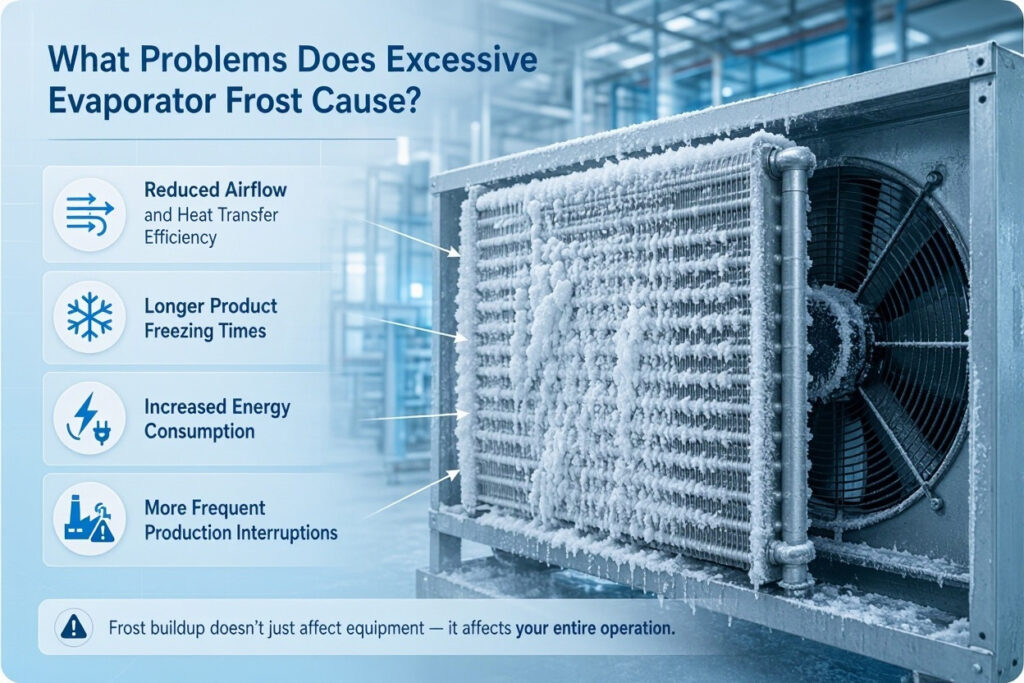
Evaporator frosting is more than a visible layer of ice on the coil. It can gradually affect the performance of the entire freezing system.
2.1 Reduced Airflow and Heat Transfer Efficiency
As frost accumulates between evaporator fins, the available air passages become progressively narrower.
This increases air-side resistance and reduces the actual airflow delivered by the fans.
As air circulation deteriorates, heat transfer between the evaporator and circulating air also becomes less effective. Consequently, the freezer may struggle to maintain its intended freezing conditions.
2.2 Longer Product Freezing Times
Reduced airflow and heat transfer efficiency increase the time required for products to reach their target core temperatures.
In continuous production, this may lead to:
- Reduced actual production capacity.
- Less uniform product freezing.
- Inconsistent product discharge temperatures.
- Difficulty maintaining specified product quality and temperature requirements.
For IQF freezers, uneven airflow can also affect product suspension, individual particle separation, and freezing consistency.
2.3 Increased Energy Consumption
Frost creates additional thermal resistance on evaporator surfaces while restricting airflow through the fins.
As heat transfer performance deteriorates, the refrigeration system may need to operate longer to meet the required cooling load. Fan operating conditions may also become less favorable.
In addition, every defrost cycle requires the evaporator to be heated. After defrosting, the coil must be cooled down again before normal freezing operation can resume.
Therefore, both insufficient defrosting and unnecessary frequent defrosting can reduce the overall energy efficiency of the system.
2.4 More Frequent Production Interruptions
For continuous freezing equipment such as spiral freezers and tunnel freezers, defrosting operations can interfere with normal production.
If the equipment does not incorporate suitable sectional or sequential defrosting arrangements, frequent defrost cycles may require production to stop, reducing effective operating hours.
This is particularly important for food processing plants operating multiple shifts or working under strict delivery schedules.
3. Three Common Defrosting Methods for Industrial Freezers
Different defrosting methods are suitable for different evaporator configurations, refrigeration systems, and production conditions.
The three commonly used methods in industrial refrigeration are water defrost, hot-gas defrost, and air defrost.
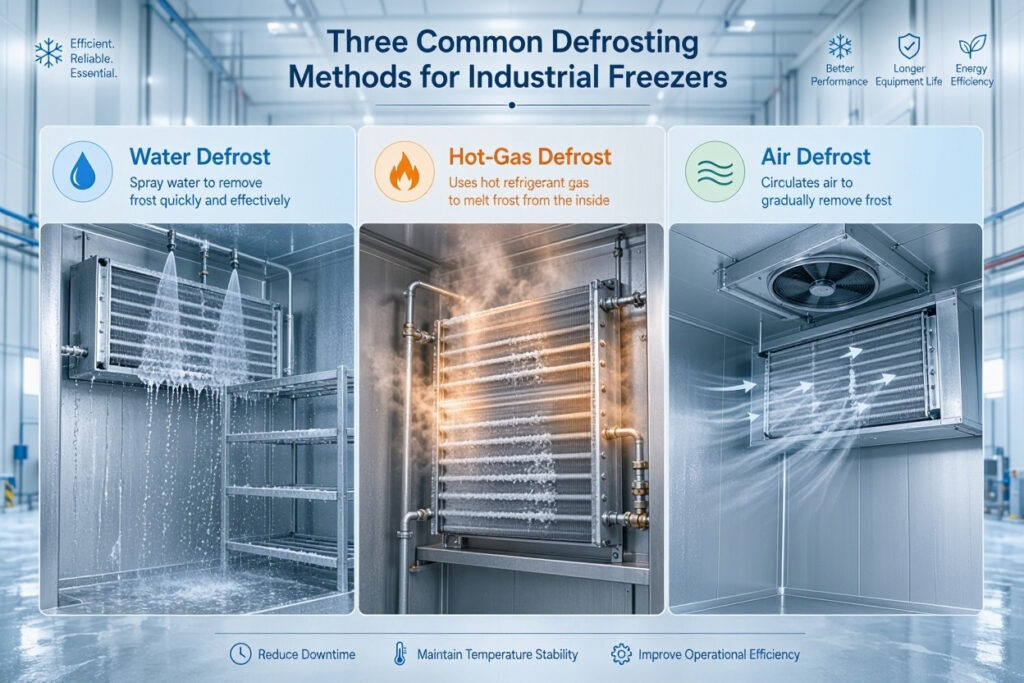
3.1 Water Defrost
Water defrost uses controlled water spraying to melt and remove accumulated frost from evaporator surfaces.
Advantages:
- Relatively fast defrosting.
- Effective at removing thick frost accumulation.
- Suitable for certain industrial evaporator configurations.
Limitations:
- Requires a reliable water supply and drainage system.
- Generates additional wastewater.
- Proper drainage design is essential to prevent residual water from refreezing.
- Water temperature, spray distribution, and defrost duration must be controlled.
Water defrost is commonly used in industrial freezing equipment where substantial frost removal is required. However, it must be properly integrated with the equipment’s hygiene and drainage design.
3.2 Hot-Gas Defrost
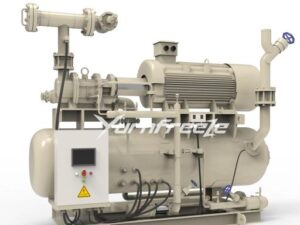
Hot-gas defrost uses high-temperature refrigerant vapor from the discharge side of the refrigeration system to heat the evaporator coil and melt accumulated frost.
Advantages:
- Does not rely on large quantities of external water.
- Widely established in industrial refrigeration systems.
- Can be integrated with automated refrigeration control systems.
Limitations:
- Requires specially designed piping, valves, and control systems.
- Incorrect defrost sequencing or pressure control may cause operational and mechanical problems.
- The refrigeration system must have an appropriate hot-gas supply arrangement.
Hot-gas defrost is widely used in industrial refrigeration, particularly in ammonia refrigeration systems. Its actual performance depends heavily on proper piping design and control logic.
3.3 Air Defrost
Air defrost generally works by stopping refrigeration to the evaporator while allowing warmer air to continue passing over the coil, gradually melting or sublimating the accumulated frost.
Advantages:
- Relatively simple system configuration.
- No additional water supply or hot-gas piping is required.
- Suitable for certain applications where surrounding air temperature is sufficiently high.
Limitations:
- Generally slower than water or hot-gas defrost.
- Unsuitable for many deep-freezing applications.
- Defrosting effectiveness depends heavily on ambient temperature and frost accumulation.
Air defrost is therefore generally more suitable for higher-temperature refrigeration applications rather than deep-freezing equipment operating at very low temperatures.
Comparison of Three Common Defrosting Methods
| Defrost Method | Working Principle | Main Advantages | Key Considerations |
|---|---|---|---|
| Water Defrost | Warm water melts accumulated frost | Effective and relatively fast | Water consumption, drainage, and hygiene |
| Hot-Gas Defrost | High-temperature refrigerant vapor heats the coil | Suitable for industrial refrigeration systems | Piping design, pressure control, and sequencing |
| Air Defrost | Warmer air melts or sublimates frost | Relatively simple configuration | Slower operation and dependence on ambient temperature |
The appropriate defrosting method should be selected according to evaporator configuration, operating temperature, frost load, available utilities, sanitation requirements, and production schedules.
4. How Can You Reduce Defrosting Frequency in Industrial Freezers?
Reducing unnecessary defrost cycles does not mean eliminating defrosting altogether. The objective is to control frost accumulation and initiate defrosting only when necessary.
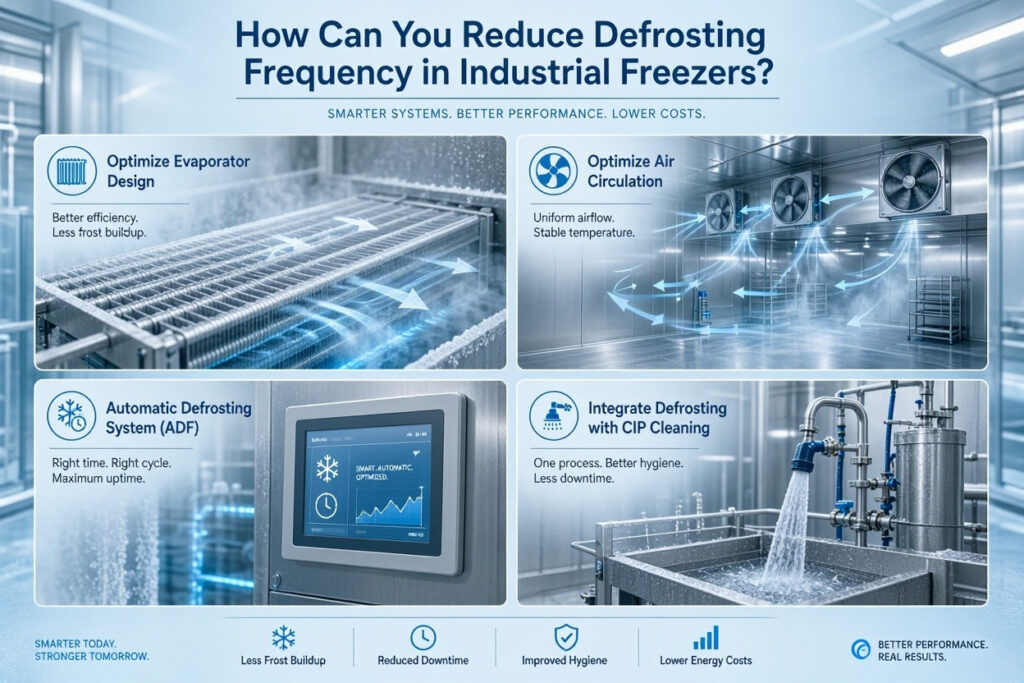
4.1 Optimize Evaporator Design
Evaporator selection should consider more than nominal refrigeration capacity.
Important design factors include:
- Fin spacing appropriate for the expected frost load.
- Sufficient heat transfer surface area.
- Reasonable air-side pressure drop.
- Uniform air distribution across different evaporator sections.
- Structural accessibility for inspection and cleaning.
If an evaporator is poorly matched to actual operating conditions, it may require more frequent defrosting even when its nominal refrigeration capacity appears sufficient.
4.2 Optimize Air Circulation
Stable airflow is essential for achieving uniform heat transfer in industrial freezing equipment.
The following factors should be carefully evaluated:
- Fan capacity and operating speed.
- Air distribution across different freezing zones.
- Air leakage or airflow bypass around the evaporator.
- Product loading patterns on the conveyor belt.
- Ice accumulation around fan blades and air passages.
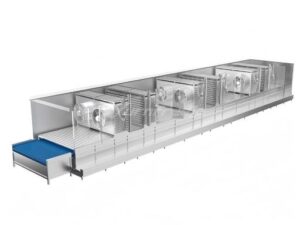
For spiral and tunnel freezers, airflow design must account for both evaporator positioning and product movement through the freezing chamber.
When evaluating industrial spiral freezer solutions, Yurnfreeze considers evaporator configuration, airflow distribution, conveyor belt structure, and ease of cleaning as interconnected engineering factors. This is particularly important for continuous production lines that require stable freezing performance and effective frost management.
4.3 Introduce an Automatic Defrosting System (ADF)
An Automatic Defrosting System (ADF) can coordinate defrosting operations according to programmed schedules or actual equipment operating conditions.
Depending on the system configuration, defrost initiation and termination may be based on:
- Operating time intervals.
- Evaporator temperature.
- Differential pressure across the evaporator.
- Airflow or other measurable operating parameters.
Demand-based defrost control can initiate defrosting in response to performance deterioration caused by frost accumulation, rather than relying entirely on fixed time intervals. This helps reduce unnecessary defrost operations.
However, sensor selection, control logic, and defrost termination settings must be properly configured and commissioned. An ADF system cannot replace moisture management or compensate for an improperly selected evaporator.
4.4 Integrate Defrosting with CIP Cleaning
Defrosting and cleaning are two different processes.
Defrosting primarily removes accumulated ice from equipment surfaces, while Clean-in-Place (CIP) systems are designed to clean suitable product-contact areas and equipment surfaces without requiring complete manual disassembly.
In food processing applications, integrating suitable CIP cleaning arrangements with an appropriate defrost sequence can improve sanitation management and reduce manual disassembly and cleaning requirements.
However, CIP cannot replace defrosting. Both processes should be coordinated according to equipment configuration, cleaning chemicals, drainage arrangements, and food safety requirements.
5. Conclusion: Effective Frost Management Starts with System Design
Frequent frost buildup is often a symptom rather than the root cause of an operational problem.
Excessive moisture entering the freezer, unsuitable evaporator fin spacing, insufficient airflow, increased production loads, and improper defrost control can all accelerate frost accumulation.
Simply increasing defrost frequency may temporarily restore airflow, but it does not necessarily solve the underlying problem. It may also increase energy consumption and production interruptions.
A more effective approach combines appropriate evaporator selection, moisture management, airflow optimization, automatic defrost control, and hygienic equipment design.
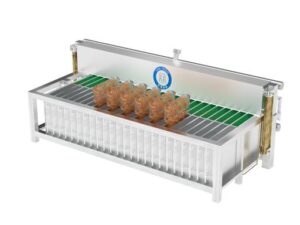
In the engineering of Yurnfreeze IQF fluidized bed, spiral, and tunnel freezers, these factors are evaluated together according to the specific application. Depending on product characteristics and operating conditions, equipment can incorporate automatic defrosting arrangements, CIP cleaning systems, and evaporator and airflow configurations matched to actual production requirements.
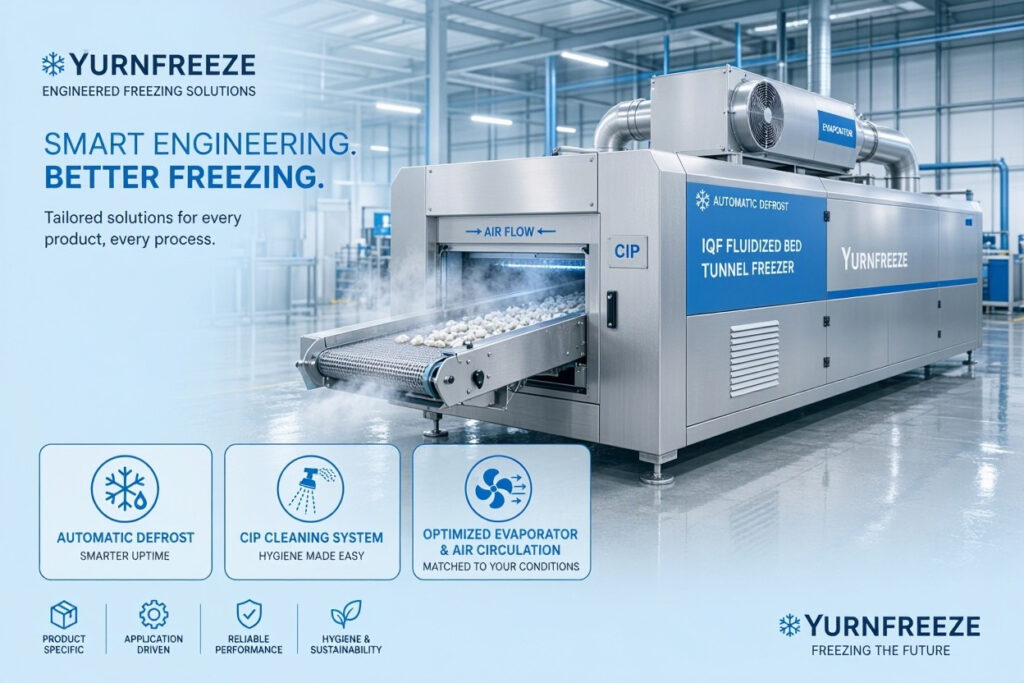
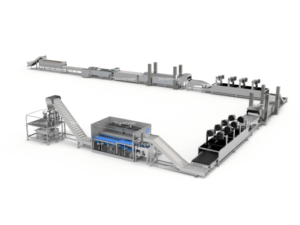
For existing freezing lines, evaluating the original equipment dimensions, production capacity, evaporator configuration, and refrigeration connections can also help determine whether a targeted upgrade or a newly engineered replacement is more appropriate than simply increasing defrost frequency.
The real objective is not to defrost more frequently, but to maintain stable and efficient freezing performance through the right defrosting strategy.
FAQ
1. How often should an industrial freezer be defrosted?
There is no fixed defrosting interval that applies to all industrial freezers. The actual frequency depends on operating temperature, product moisture content, ambient humidity, production hours, and evaporator design.
Some equipment uses scheduled defrost cycles, while other systems determine when defrosting is required based on parameters such as temperature, differential pressure, or airflow. The appropriate interval should be established according to actual operating conditions and evaporator performance.
2. Why does frost build up again shortly after defrosting?
Rapid frost accumulation shortly after defrosting usually indicates that the underlying moisture source or operating condition has not been addressed.
Common causes include humid air entering through freezer openings, excessive surface moisture on incoming products, high ambient humidity, and insufficient drainage after water defrosting.
If the evaporator becomes heavily frosted again within a short period, inspect the freezer sealing, product dewatering process, drainage system, and evaporator operating conditions rather than simply increasing defrost frequency.
3. Can frequent defrosting damage frozen food or affect product quality?
If properly controlled, frequent defrosting does not necessarily damage products directly. However, repeated production interruptions, temperature fluctuations, and prolonged exposure to warmer air may affect product quality.
For continuous freezing lines, defrosting should be coordinated with production schedules and product temperature requirements. Where appropriate, sectional or sequential defrosting can allow other sections of the system to continue operating.
4. Can an industrial freezer continue operating during defrosting?
This depends on the equipment configuration and defrosting system design.
Some industrial spiral freezers incorporate sectional or sequential defrosting arrangements, allowing selected evaporator sections to be defrosted while other sections continue operating. However, this requires properly designed refrigeration circuits, airflow arrangements, and control logic.
For conventional systems without these configurations, production generally needs to stop during defrosting to ensure effective frost removal and safe operation.