

Self-Supporting Belt Design in Spiral Freezers: The Key to a 100% Hygienic Product Zone
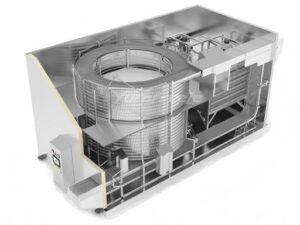
A self-supporting belt system in a spiral freezer eliminates internal supports like glide strips, creating a fully open and cleanable product zone. This design improves hygiene, reduces contamination risks, and enhances freezing efficiency in food processing.
In industrial food freezing, contamination risk and cleaning complexity remain two of the biggest operational challenges.
Traditional spiral freezers rely on internal supports, glide strips, and structural components inside the product zone—creating hidden areas where debris, bacteria, and moisture can accumulate.
But what if the product zone could be completely open, fully cleanable, and free of internal obstructions?That’s exactly what a self-supporting belt design achieves.
What Is a Self-Supporting Belt in a Spiral Freezer?
A self-supporting belt system means the conveyor belt forms its own structural support as it travels through the spiral.Unlike conventional systems:
- No internal rails or glide strips are required
- No support structures exist inside the product zone
- The belt maintains stability through its own design
This fundamentally changes how a spiral freezer is engineered—and how hygienic it can be.
Why Hygienic Product Zone Design Matters in Food Freezing
Food manufacturers—especially in meat, seafood, poultry, and ready meals—face strict hygiene requirements:
- HACCP compliance
- Export standards (EU / Australia / US)
- Cross-contamination prevention
Traditional Spiral Design VS Self-Supporting Design:
| Aspect | Traditional Design | Self-Supporting Design |
|---|---|---|
| Product Zone Structure | Internal supports create dead zones | Fully open product zone |
| Cleanability | 30–60% hard-to-clean areas present | Easy full access for cleaning |
| Contamination Risk | Food particles accumulate over time | No hidden contact surfaces |
| Maintenance Method | Requires disassembly | Simplified cleaning process |
| Production Impact | Downtime during cleaning | Faster and more efficient cleaning |
100% Cleanable Design: What It Really Means
“100% cleanable” is often used in marketing—but in engineering terms, it means:
- Full physical accessibility: All surfaces can be reached by water, foam, or CIP systems
- No shadow zones: No structural barriers blocking cleaning flow
- Minimal horizontal surfaces: Reduces water and residue accumulation
- Open airflow + drainage design: Faster drying after sanitation
This is critical for:
- IQF products
- Sticky or coated foods
- High-frequency production lines
No Glide Strips or Internal Supports: Eliminating Contamination Sources
In conventional spiral freezers, glide strips are used to support the belt—but they introduce multiple risks:
- Contamination risks: Food debris accumulates along contact surfaces
- Mechanical wear: Friction generates particles over time
- Maintenance burden: Frequent replacement and inspection required
By eliminating glide strips:
- Product zone becomes mechanically simpler
- Risk of foreign body contamination is reduced
- Maintenance intervals are extended
This hygienic-driven design concept is widely adopted by advanced spiral freezer manufacturers such as Yurnfreeze, which focuses on industrial IQF freezing systems designed for high hygiene standards and continuous food production environments.
How Product Zone Design Impacts Freezing Efficiency
Hygiene is only part of the story—this design also improves freezing performance.
- Improved airflow distribution: No structural blockage → more uniform cold air flow
- Better heat transfer: Direct exposure to airflow enhances freezing speed
- Reduced energy loss: Less turbulence and obstruction
Applications That Benefit Most from This Design
Self-supporting belt spiral freezers are especially suitable for:
| Industry | Key Benefit |
|---|---|
| Poultry processing | High hygiene compliance |
| Seafood | Reduced contamination risk |
| Ready meals | Handles complex shapes |
| Bakery & coated products | Prevents sticking and buildup |
How to Choose the Right Spiral Freezer Design
When evaluating suppliers, focus on:
- Whether the product zone is fully open
- Belt structure design (self-stacking or supported)
- Cleaning accessibility
- Compliance with international hygiene standards