

Uneven freezing, product sticking, and high energy costs can quietly reduce frozen food profits. In many cases, the real problem is not refrigeration capacity — but airflow design.
Vertical controlled air flow improves IQF freezing quality by increasing heat transfer efficiency, stabilizing products on the belt, reducing energy loss, and ensuring uniform freezing across the entire spiral freezer system.
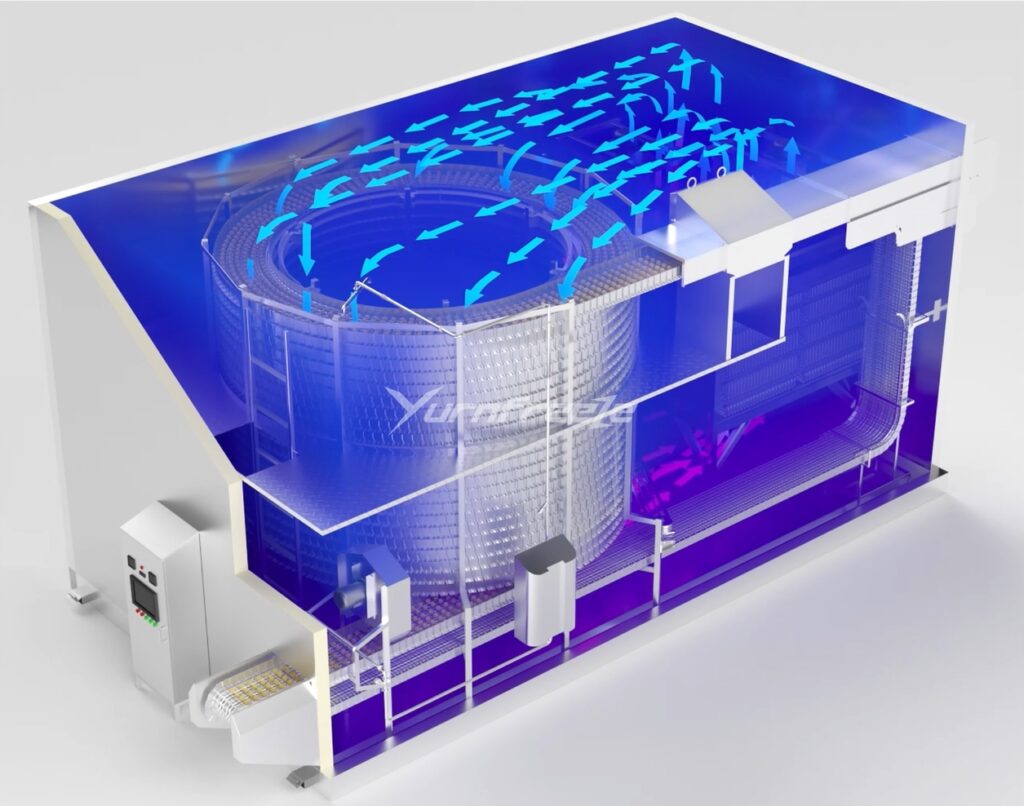
How Does Vertical Controlled Air Flow Improve Heat Transfer in a Self-stacking Spiral Freezer?
Heat transfer speed directly affects freezing quality, production capacity, and product appearance in an IQF spiral freezer.
Vertical controlled airflow improves heat transfer by forcing cold air evenly through the product layer, while counter-current airflow maximizes temperature difference and freezing efficiency throughout the spiral belt.
In traditional horizontal airflow systems, cold air moves across the conveyor belt surface. This design often creates uneven airflow zones. Products closer to the air outlet freeze faster, while products farther away receive weaker airflow.
Vertical airflow changes this process completely.Instead of pushing air sideways, the system drives cold air vertically through the product layer. This creates more direct contact between cold air and product surfaces.
Why Counter-Current Airflow Matters?
Counter-current airflow means the coldest air meets the coldest product zone. This maintains a stronger temperature gradient during the entire freezing process. A stronger temperature difference means faster heat transfer. The result is:
- Faster crust freezing
- Reduced moisture loss
- Better product texture
- More uniform core temperature
Why Uniform Product Temperature Is Critical?
When airflow distribution is inconsistent, some products become overfrozen while others remain underfrozen. This creates quality control problems during storage and export.
Large food factories in Southeast Asia and Latin America increasingly prioritize uniform freezing because export buyers demand consistent appearance and texture.
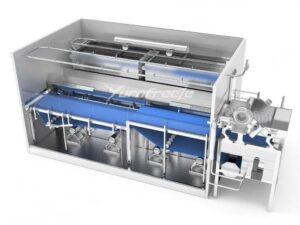
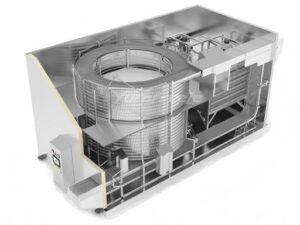
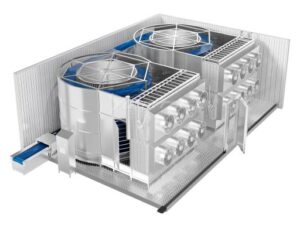
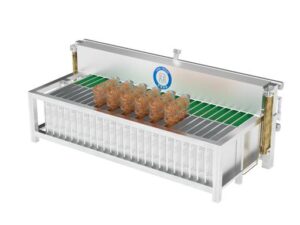
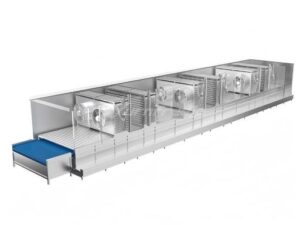
YURNFREEZE self-stacking spiral freezers are designed with optimized vertical airflow channels and balanced evaporator systems to improve airflow penetration and maintain stable freezing conditions across the full belt width.
Why Does a Counter-Current Airflow System Prevent Product Movement and Improve Stability?
Product stability is often overlooked in IQF freezing, but unstable airflow can damage both freezing quality and production efficiency.
Counter-current vertical airflow reduces product movement by minimizing horizontal air pressure across the belt, helping products remain separated, stable, and evenly frozen during the entire freezing cycle.
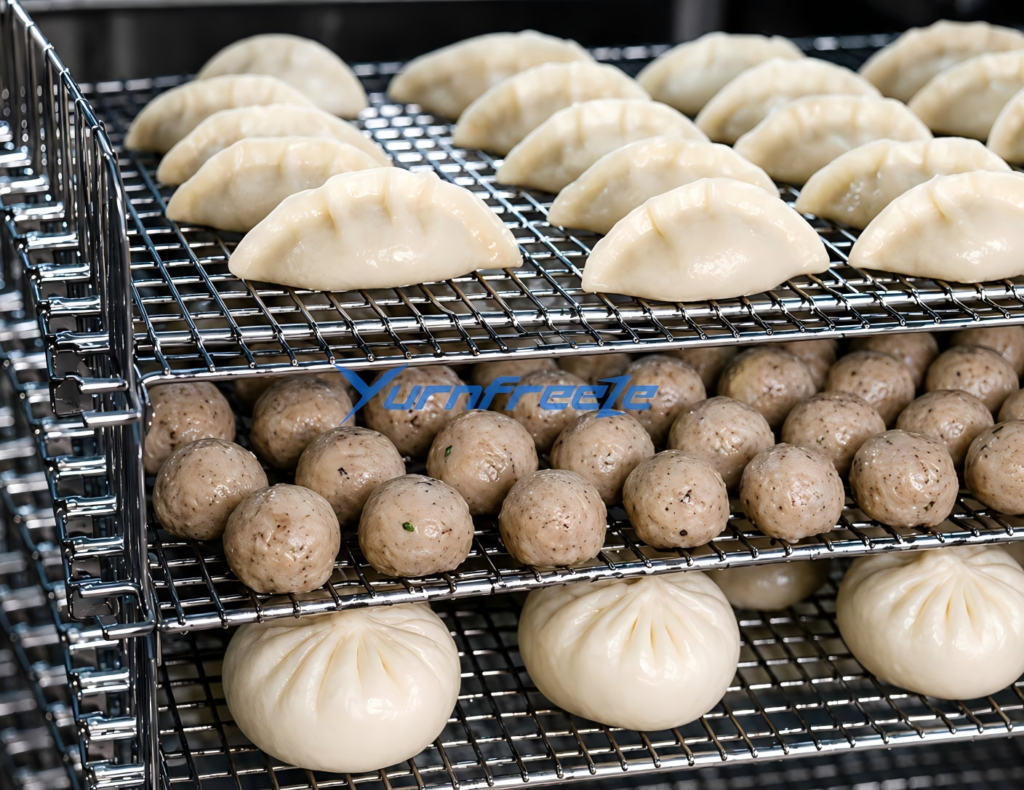

Horizontal airflow systems can create strong side pressure across lightweight products.This commonly causes:
- Product drifting
- Product rolling
- Uneven piling
- Product collision
- Surface damage
These problems are especially serious for fragile products.
Why Stable Products Improve IQF Separation?
IQF systems depend on keeping each product individually separated during freezing. Once products move or overlap, several issues appear:
- Incomplete freezing
- Product clumping
- Reduced visual quality
- Difficult downstream packaging
The Hidden Impact on Production Capacity
Unstable products can also force operators to lower belt loading density to avoid sticking problems.This reduces total production output. A well-designed airflow system allows factories to:
- Increase loading capacity
- Maintain product separation
- Reduce product waste
- Improve production consistency
Vertical vs Horizontal Airflow Comparison
| Feature | Vertical Controlled Airflow | Horizontal Airflow |
|---|---|---|
| Air distribution | Even across belt | Uneven across belt width |
| Heat transfer efficiency | High | Medium |
| Product movement risk | Low | Higher |
| IQF separation effect | Better | Less stable |
| Freezing consistency | Uniform | Variable |
YURNFREEZE self-stacking spiral freezers are designed for stable airflow circulation with customizable airflow velocity according to product type and freezing capacity requirements. Get free design→
Why Does Airflow Design Directly Affect Energy Consumption in IQF Freezing Systems?
Many food factories focus only on compressor specifications, while ignoring how airflow resistance affects total energy consumption.
Optimized airflow design reduces fan resistance, improves cooling efficiency, shortens freezing time, and lowers total energy consumption in industrial IQF freezing systems.
In industrial freezing systems, fan motors consume a large amount of electricity every day. Poor airflow design forces fans to work harder.This increases:
- Fan power consumption
- Frost accumulation
- Compressor load
- Maintenance frequency
How Optimized Airflow Reduces Energy Waste
Efficient airflow systems minimize turbulence and airflow resistance. Cold air reaches the product more directly, which means:
- Faster heat exchange
- Shorter freezing cycles
- Lower evaporating temperature loss
- Reduced compressor operation time
Relationship Between Airflow and Energy Efficiency
| Airflow Condition | Energy Impact |
|---|---|
| Uneven airflow | Higher power consumption |
| High airflow resistance | Increased fan load |
| Frost buildup | Reduced heat transfer |
| Balanced airflow | Lower operating cost |
| Faster freezing | Higher production efficiency |
Conclusion
Vertical controlled airflow is not just a freezer feature. It directly influences freezing quality, energy efficiency, hygiene performance, and long-term production reliability in modern IQF processing.