





Sticky products, uneven freezing, and product clumping can reduce IQF quality and increase production loss. Modern air pressure pulsation systems solve these problems through controlled airflow movement.
Air pressure pulsation improves product separation, stabilizes fluidization, and enhances freezing uniformity in modern IQF fluidized bed freezers. It is especially effective for delicate, high-moisture, and sticky food products during crust freezing.
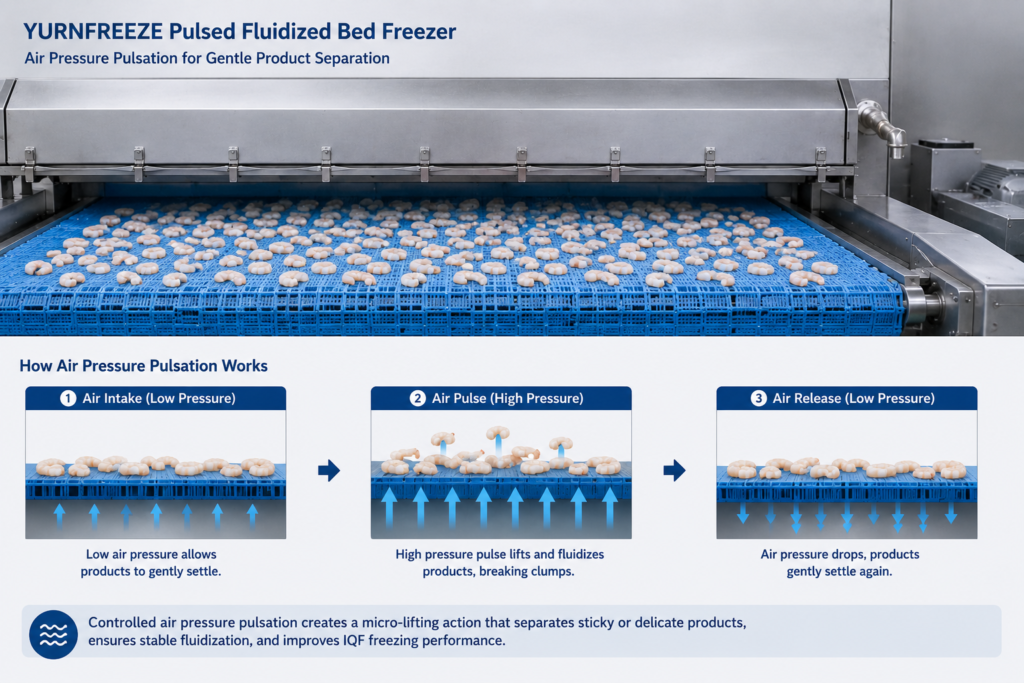
What Is a Fluidized Bed Pulsation System in IQF Freezing Technology?
A fluidized bed pulsation system controls air pressure and airflow frequency beneath the product bed. This dynamic airflow gently lifts and separates products to improve IQF freezing performance.
In a standard IQF fluidized freezer, cold air continuously passes through the conveyor bed. This airflow lifts products and creates a fluidized state. However, products with high surface moisture often stick together before crust freezing is completed.
Pulsation technology changes this process. Instead of using constant airflow, the system creates controlled air pressure variations. These micro-pulses help products move independently without excessive mechanical agitation.
Why Is Pulsation Important During Crust Freezing?
The crust freezing stage is one of the most sensitive phases in IQF processing. Surface ice begins forming, but the product core remains soft.
Without proper separation, products may develop:
- Clusters
- Ice bridges
- Deformation
- Uneven freezing
Pulsation minimizes these risks by improving product mobility while maintaining gentle handling.
How Does the Pulsation Process Work?
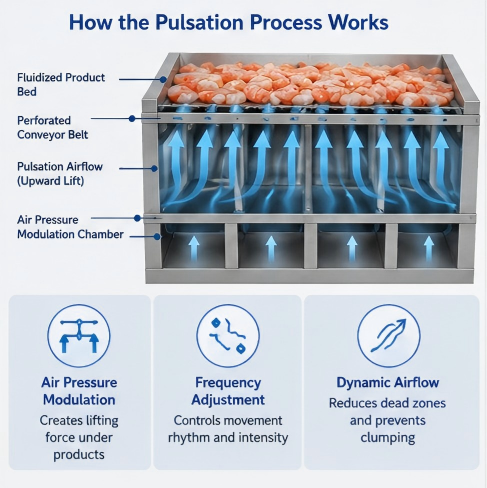
| Function | Role in IQF Freezing |
|---|---|
| Air Pressure Modulation | Creates lifting force under products |
| Frequency Adjustment | Controls movement rhythm |
| Dynamic Airflow | Reduces dead zones and clumping |
| Gentle Product Separation | Protects delicate product surfaces |
Why Are More Processors Adopting Pulsation Systems?
Global frozen food manufacturers are increasingly focused on:
- Higher IQF product quality
- Lower dehydration loss
- Better freezing consistency
- Reduced product waste
- Lower energy consumption
This is especially important in export-oriented seafood and fruit processing industries across Southeast Asia and Latin America.
As a professional quick freezing equipment manufacturer, YURNFREEZE designs customizable IQF fluidized bed freezer systems for different product characteristics and production capacities. Flexible airflow control is becoming a key requirement for modern frozen food factories.
How Does Pulsation Compare to Traditional Fluidization or Agitation Systems?
Compared with traditional airflow or mechanical agitation systems, pulsation technology provides gentler product separation, more stable fluidization, and better protection for delicate IQF products.
Traditional IQF systems mainly rely on constant airflow or mechanical vibration. These methods can separate products, but they may also create operational problems.
Main Limitations of Traditional Continuous Airflow
Continuous airflow sometimes causes:
- Uneven bed pressure
- Product overlap
- Poor fluidization stability
- Excessive product movement
- Surface damage on soft products
This becomes more serious when processing sticky or juicy foods.
Problems With Mechanical Agitation
Some systems use mechanical shaking or vibration to separate products. While effective in some applications, mechanical agitation may increase:
- Product breakage
- Equipment wear
- Maintenance requirements
- Noise levels
For delicate seafood or fruit products, excessive mechanical movement can reduce final product appearance and market value.
Pulsation vs Traditional Systems
| Feature | Pulsation System | Traditional Airflow | Mechanical Agitation |
|---|---|---|---|
| Product Separation | Gentle | Moderate | Aggressive |
| Product Damage Risk | Low | Medium | Higher |
| Fluidization Stability | High | Medium | Medium |
| Suitable for Delicate Products | Excellent | Limited | Limited |
| Maintenance Demand | Moderate | Low | Higher |
How Does Pulsation Technology Improve Overall IQF Efficiency and Yield?
Pulsation technology improves IQF efficiency by enhancing heat transfer, stabilizing airflow distribution, reducing product loss, and increasing freezing consistency across the production line.
Efficient fluidization directly affects freezing performance. When products separate evenly, cold air contacts more surface area. This improves heat exchange efficiency.
Key Efficiency Benefits of Pulsation
Better Heat Transfer
Uniform product movement exposes more product surfaces to cold air.
This can help:
- Improve freezing consistency
- Reduce temperature variation
- Shorten freezing time
Reduced Product Clumping
Clumped products freeze unevenly and often require reprocessing. Pulsation minimizes early-stage sticking.
Lower Product Loss
- Gentler separation reduces:
- Product breakage
- Surface cracking
- Dehydration loss
Improved Production Stability
Stable fluidization can reduce operational interruptions caused by:
- Product buildup
- Uneven bed loading
- Airflow instability
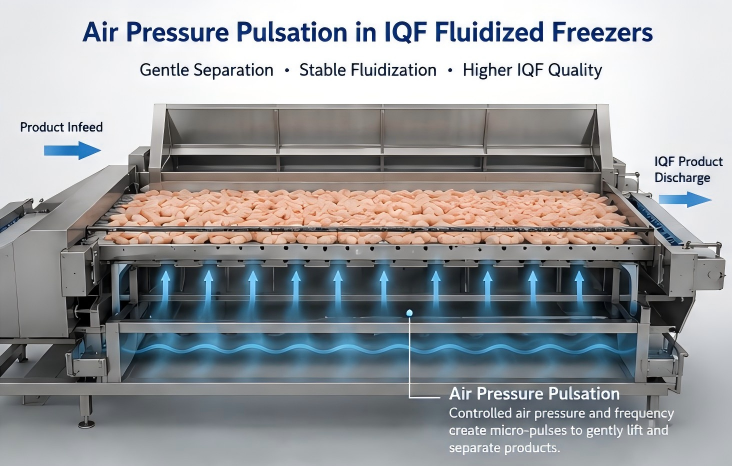
Impact on Energy Consumption
Energy efficiency is becoming increasingly important for frozen food factories due to rising electricity costs.Pulsation systems may improve refrigeration efficiency by:
Optimizing airflow usage
Reducing unnecessary over-freezing
Improving thermal transfer efficiency
Although exact savings vary by product and line configuration, stable fluidization generally supports more efficient freezer operation.
What Types of Products Benefit Most From Fluidized Bed Pulsation Technology?
Fluidized bed pulsation technology is especially suitable for soft, sticky, juicy, or delicate products that require gentle separation and stable individual quick freezing performance.
Not all products behave the same way inside an IQF freezer.
Products with high moisture or sugar content tend to stick together during crust freezing. Soft surfaces can also become damaged under unstable airflow conditions.
Products That Commonly Benefit From Pulsation
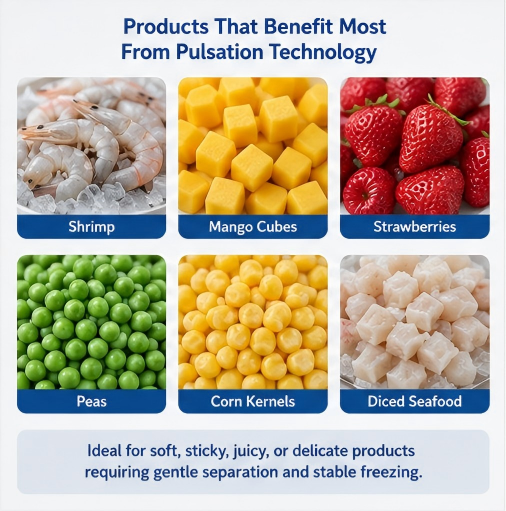
| Product Type | Main Freezing Challenge |
|---|---|
| Shrimp | Surface sticking |
| Mango cubes | High sugar content |
| Strawberries | Soft structure |
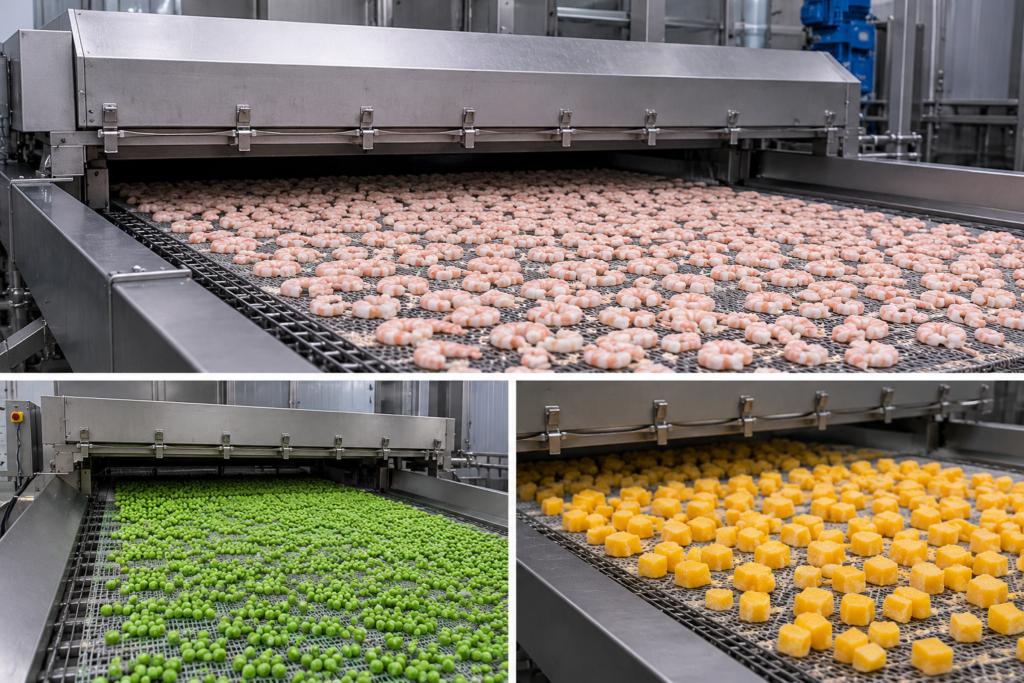
| Peas | Product clustering |
| Corn kernels | Uneven fluidization |
| Diced seafood | Surface damage risk |
Growing Demand for Flexible IQF Systems
Modern frozen food factories increasingly process multiple product categories on one production line.
As a customizable IQF freezer manufacturer, YURNFREEZE provides fluidized bed freezer solutions designed for different freezing capacities, product characteristics, and factory layouts. Get free design→
Conclusion
Air pressure pulsation is helping modern IQF fluidized freezers achieve gentler product separation, better freezing consistency, improved yield, and higher operational efficiency across demanding frozen food applications.