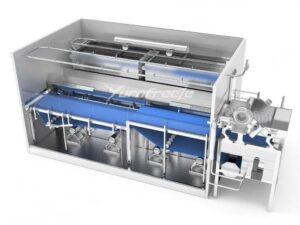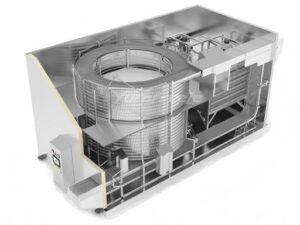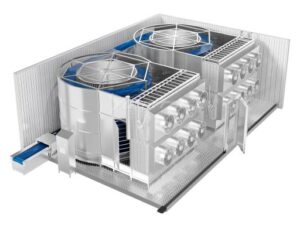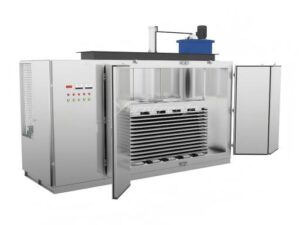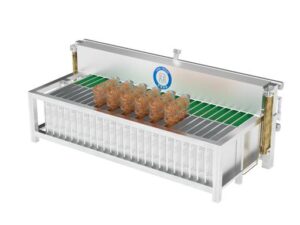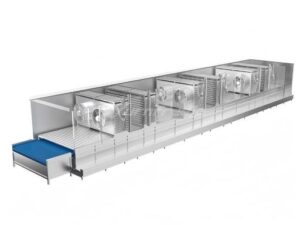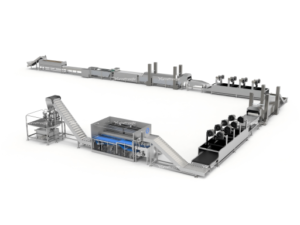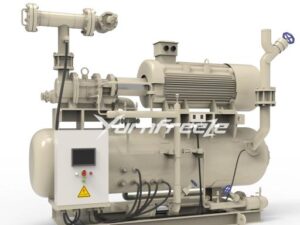


Industrial freezers power continuous food production with large-scale, high-speed freezing systems. They process high volumes of products quickly while preserving product quality, food safety, and overall processing efficiency.
Today, these systems form a critical link in modern food supply chains, supporting everything from seafood and meat processing to frozen vegetable and prepared meal manufacturing. You may wonder what sets industrial blast freezers apart from standard commercial freezers, or which model aligns best with your existing production line. This guide breaks down core technologies, compares key performance metrics, and walks you through a step-by-step selection process.
What Is an Industrial Freezer?
Industrial freezers go far beyond oversized cold storage units. Engineers build them as dedicated production systems optimized for speed, consistent performance, and seamless automation.
Food processing operations use these systems to freeze large product volumes in either continuous or batch modes. They run at temperatures typically ranging from -30°C to -40°C, which delivers rapid freezing results and locks in food quality.
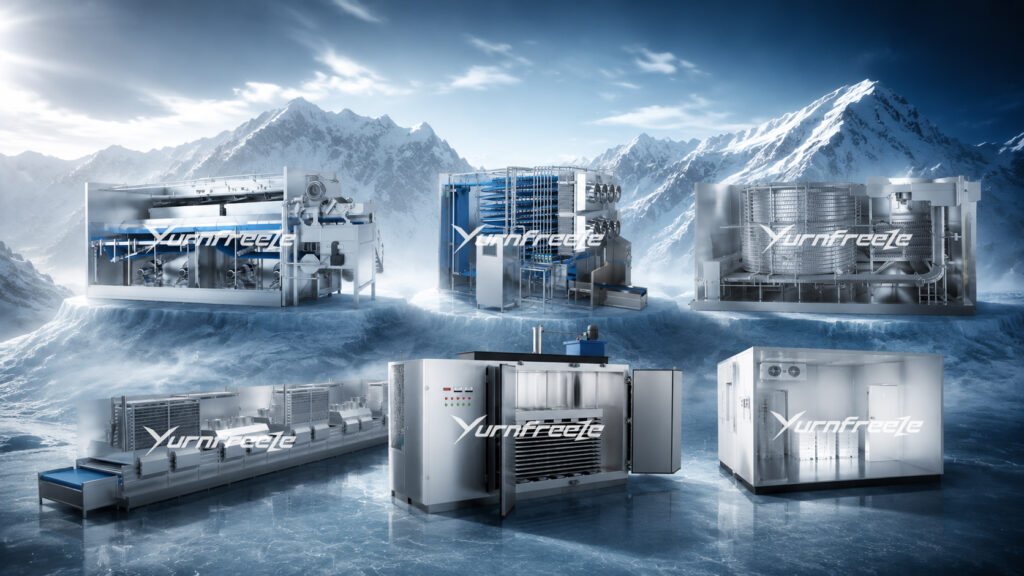
Industrial Freezer Comparison Table
The table below compares five mainstream industrial freezer types across core performance and operational factors.
| Comparison Factor | Fluidized Bed Freezer | Spiral Freezer (Conventional & Self-stacking) | Tunnel Freezer | Plate Freezer (Horizontal & Vertical) | Blast Freezer |
|---|---|---|---|---|---|
| Best Application | Small individual products | High-volume production | Flexible products | Blocks/packages | Batch freezing |
| Typical Capacity | 500–5000 kg/h | Conventional: Approx.300–6000+ kg/h Self-stacking: Approx.500–3000+ kg/h | 100–2000 kg/h | Horizontal: 200–2288 kg/batch Vertical: 500–1500 kg/batch (customizable) | 100–2000 kg/batch |
| Freezing Temperature | -30~-40℃ | -35~-40℃ | -30~-40℃ | -30~-40℃ | -30~-40℃ |
| IQF Performance | ★★★★★ | ★★★★ | ★★★ | ★★ | ★ |
| Product Size Range | Small | Medium/Large | Small/Large | Flat products | Various |
| Space Efficiency | ★★★ | ★★★★★ | ★★ | ★★★★ | ★★ |
| Automation Level | High | High | Medium-High | Medium | Low-Medium |
| Investment Level | Medium | High | Medium | Medium | Low |
| Best Industries | Seafood, fruits, vegetables | Meat, bakery, prepared foods | Seafood, meat, vegetables | Seafood blocks,meat products | Small factories |
Data sources: We base this comparison on refrigeration technology publications from the International Institute of Refrigeration, ASHRAE refrigeration engineering standards, and official technical specifications from leading industrial freezer manufacturers.
Note: Star ratings reflect general industry performance under standard operating conditions. Real-world results will shift based on your exact product specifications and production environment.
Key Selection Criteria for Food Processing Quick Freezing Equipment
Match Your Freezer to Your Core Product Line
Your primary product type should drive your first equipment decision, as different freezing technologies excel with different product formats.
- For small IQF fruits and vegetables, choose a fluidized bed freezer as your primary solution. This technology delivers the most consistent export-grade IQF berry quality of all mainstream freezing methods.
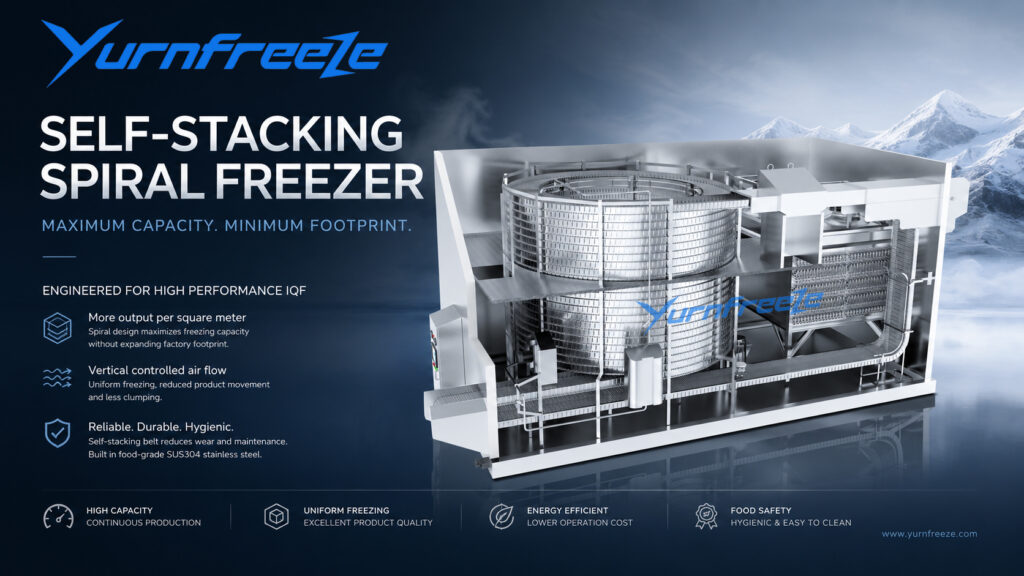
- For formed bakery items or meat products, a conventional spiral freezer works well for most lines. For high-capacity centralized production, opt for a self-stacking spiral freezer instead; it occupies less floor space, preserves better product appearance, and supports stronger continuous output.
- For large seafood items or tray-packed prepared meals, select a tunnel freezer if you run high-capacity operations with ample factory space. If you have lower output and a tighter budget, horizontal or vertical plate freezers offer a better fit. Specifically, horizontal plate freezers work best for small-batch, multi-product production, while vertical plate freezers excel at high-volume batch runs of a single product.
- For mixed-product facilities, base your main freezer selection on your highest-volume product, and add smaller auxiliary units to handle lower-volume product categories.
- For small factories that need fast startup for low-volume, multi-batch production, a blast freezer works as a solid transitional solution. Keep in mind that this batch air-blast system has relatively low automation, so it will not support long-term, continuous high-volume production efficiently.
Align Equipment Scale With Your Production Capacity
Production volume determines the appropriate system size and configuration to balance cost and efficiency.
- For small processing plants running up to 500 kg/h, choose horizontal or vertical plate freezers, single spiral freezers, or compact tunnel freezers. These options carry lower upfront investment and offer more flexible installation.
- For medium-sized plants with 500–2,000 kg/h output, use fluidized bed freezers for IQF particulate products, spiral freezers for formed items, and tunnel freezers for general-purpose freezing needs.
- For large industrial facilities with output over 2,000 kg/h, go with tunnel freezers or spiral freezers. Many of these systems support expansion for 24-hour continuous operation, so you should prioritize reliability and operational stability above all else for this scale.
Optimize for Your Available Factory Space
Your facility’s layout and physical dimensions will shape which freezer type works most effectively on site.
- If you have limited floor space but sufficient ceiling height, spiral freezers are your best option. For maximum output per square meter, select self-stacking spiral freezers, which deliver the highest vertical space utilization of any system.
- If you have a dedicated elongated workshop, tunnel freezers offer the strongest adaptability. They simplify layout planning and make routine maintenance more accessible.
- If you only have a small installation footprint, plate freezers or fluidized bed freezers work best. They demand less floor space and impose lower site preparation requirements.
Evaluate Long-Term Operational Cost Tradeoffs
Each freezer technology carries distinct cost advantages, so you should match your selection to your facility’s core operational priorities.
- If your top goal is reducing labor costs: Ranked from lowest to highest labor dependency, the order is: Fluidized Bed Freezer < Spiral Freezer < Tunnel Freezer < Plate Freezer. Higher automation levels reduce your reliance on manual loading, tray arrangement, and product sorting.
- If your top goal is controlling energy costs: Ranked from lowest to highest energy use per unit of output, the order is: Plate Freezer < Fluidized Bed Freezer < Spiral Freezer < Tunnel Freezer. In general, contact heat transfer delivers higher efficiency than air-blast convection freezing.
Frequently Asked Questions (FAQ)
Below we answer the most common questions from food processing operators evaluating industrial freezing equipment.
Q: Which type of freezer has the lowest energy consumption and is the most energy-efficient?
A: Under the same production capacity and operating conditions, plate freezers have the lowest energy consumption because contact heat transfer provides significantly higher thermal efficiency than air-blast convection freezing. Fluidized bed freezers and spiral freezers follow in terms of energy efficiency. Tunnel freezers generally have slightly higher energy consumption per unit of output due to their larger freezing chamber and relatively greater cold loss. Actual energy consumption is also affected by factors such as the initial product temperature, ambient temperature, and equipment insulation performance. Yurnfreeze can provide accurate energy consumption assessment solutions based on the actual operating conditions of each factory.
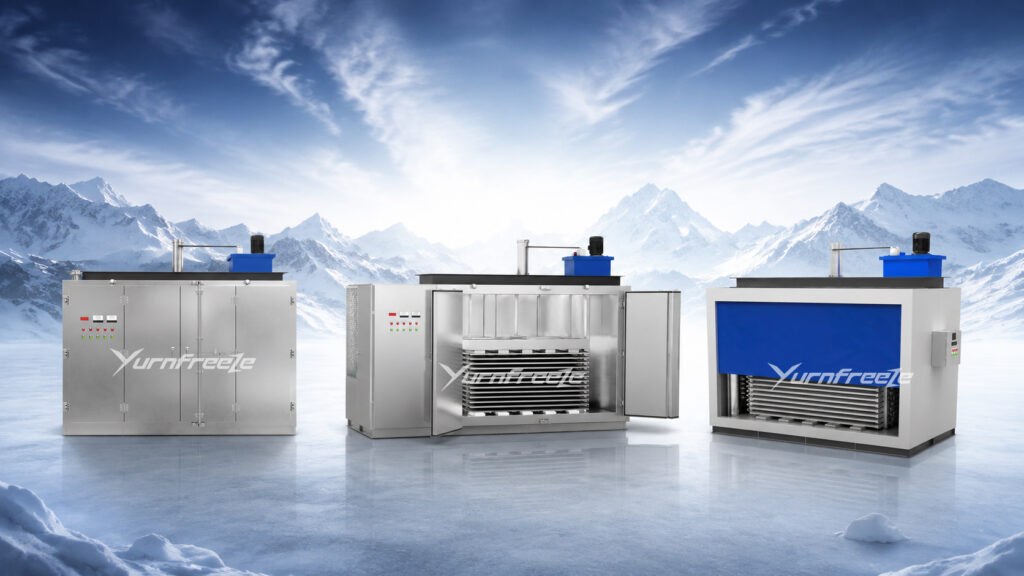
Q: For a small food processing factory with a limited budget, which type of freezer offers the best value?
A: For processing block-shaped seafood, meat patties, and similar products, a horizontal plate freezer is usually the preferred choice. It offers a lower investment cost, reduced energy consumption, simple installation, and excellent cost-performance value. For IQF fruits and vegetables or formed bakery products, a compact tunnel freezer designed for the specific product category can be considered, providing greater adaptability and more flexibility for future production expansion.
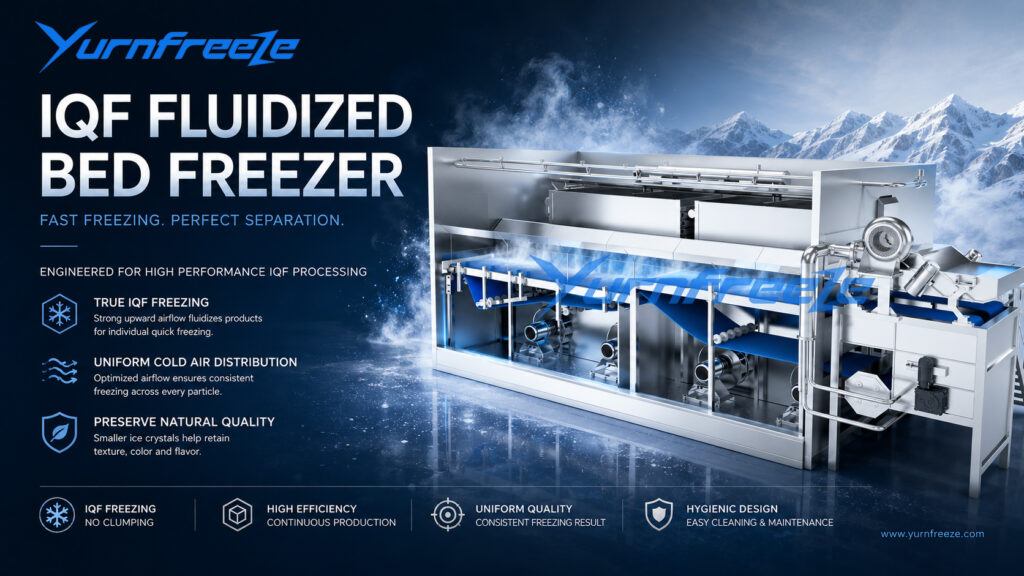
Q: Why are fluidized bed freezers the preferred choice for frozen berries?
A: High-quality IQF berries require intact individual particles, zero clumping, and low moisture loss after thawing. Fluidized bed freezers use suspended individual freezing technology, which stands as one of the most efficient mainstream solutions for consistently producing premium IQF berry products. By comparison, tunnel freezers and spiral freezers create more clumping and higher breakage rates when processing small berries, so they struggle to meet strict quality control standards.
Yurnfreeze fluidized bed freezers deliver a thawing moisture loss rate of ≤6% for products like cherries and blueberries under standard thawing conditions. This performance meets frozen fruit and vegetable quality evaluation standards and satisfies EU export market requirements.
Q: Between plate freezers and tunnel freezers, which is more suitable for freezing seafood products?
A: Your product format will determine the better choice. For block-shaped fish products, shrimp blocks, and uniform fish portions, plate freezers deliver more even freezing, better product appearance, and lower energy use. For whole fish, packaged seafood, and irregularly shaped items, tunnel freezers offer greater adaptability and work better for large-scale continuous production. Most medium and large seafood processing plants use both equipment types, with separate freezing lines assigned to different product categories.
When selecting a plate freezer, choose horizontal models for small-to-medium batch production with frequent product changeovers. For high-volume production of a single product category, go with vertical plate freezers; they deliver higher batch capacity and better labor efficiency.
Q: How should I choose between a conventional spiral freezer and a self-stacking spiral freezer?
A: Your production capacity and available factory space will drive this decision. For small-to-medium production lines running below 2,000 kg/h — especially lines processing formed food products — a conventional spiral freezer usually meets all needs. It carries lower equipment investment costs, operates more simply, and makes maintenance easier.
For production requirements above 2,000 kg/h, and especially when floor space is tight, a self-stacking spiral freezer is the better choice. It delivers higher production capacity within the same footprint, maximizes vertical space utilization, and delivers better overall cost efficiency for long-term, large-scale continuous production.
Q: Can Yurnfreeze freezing equipment replace imported brands? Can outdated imported production lines be upgraded or renovated?
A: Yes, absolutely. Yurnfreeze freezing equipment can provide same-specification replacements, production line adaptation, and customized upgrade solutions for major imported brands worldwide. Our product portfolio covers the full range of freezing technologies, including contact plate freezing, fluidized bed IQF freezing, spiral freezing, tunnel freezing, and blast freezing systems, allowing us to meet the upgrade and retrofit requirements of different factories:
Replacement Solutions by Freezer Technology
We design targeted replacement and upgrade packages for each equipment category to match your existing setup:
Plate Freezers: We deliver replacement and capacity upgrade solutions for widely used international horizontal and vertical plate freezer models, including units from DSI, Carsoe, and Optimar, plus discontinued Frigoscandia Jackstone contact plate freezers. These solutions support direct equipment replacement, production capacity upgrades, and custom retrofits for existing production lines.
Fluidized Bed IQF Freezers: We offer production line adaptation and upgrade solutions that match the performance of mainstream fluidized bed IQF freezers from brands like JBT Corporation and Frigoscandia. We design these solutions to integrate with your existing production line layout while maintaining consistent product quality standards.
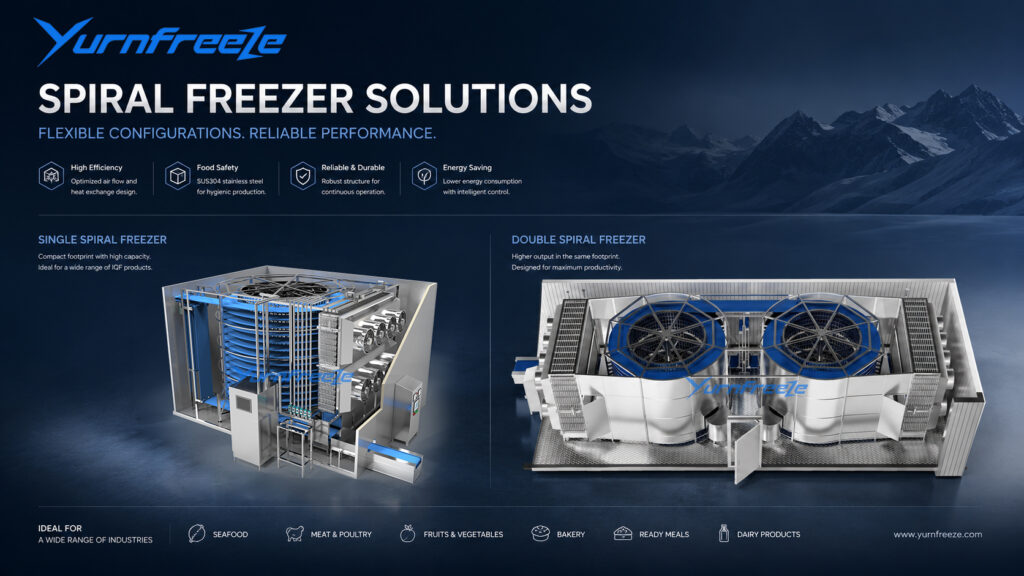
Spiral Freezers: We can replace conventional single- and double-drum spiral freezers, as well as self-stacking spiral freezer models from GEA, Linde, and JBT Corporation. We customize each unit to match your existing factory ceiling height and floor space, so you get optimized production capacity within your current installation footprint.
Tunnel Freezers: We provide upgrade and replacement solutions for tunnel freezer models from Linde and Air Products. We engineer these systems to integrate with your existing refrigeration setup and on-site installation conditions, which minimizes engineering modifications and cuts production downtime during line upgrades.
Customization & Full-Service Support
Beyond direct equipment replacement, Yurnfreeze delivers in-depth customized solutions tailored to your product dimensions, freezing capacity requirements, and automation goals. We adapt equipment to different refrigerant systems and on-site installation conditions, which helps lower your overall production line upgrade and retrofit costs.
We also back every project with extensive overseas project experience, remote technical support, and a comprehensive spare parts service system. This support lets you complete production line upgrades with shorter delivery cycles and better overall cost efficiency, all while preserving freezing quality and production performance. Among freezing equipment manufacturers of similar scale, Yurnfreeze stands as one of the few Chinese companies with independent R&D capabilities that can match the precision standards of advanced European and American freezing manufacturing technology.
Data & Compliance Statement
We base all performance parameters in this guide on standard industrial production conditions: inlet material core temperature ≤10°C, outlet material core temperature ≤-18°C, and ambient temperature of 25°C. Actual results will vary based on product specifications, feeding conditions, and operating environments.
All food contact parts on Yurnfreeze food freezing equipment use food-grade 304 stainless steel or aluminum. These materials comply with the EU EC 1935/2004 Food Contact Materials Regulation and US FDA 21 CFR Part 110 Food Contact Safety Standard, and meet market access requirements for European and American food processing facilities.
We can provide CE certification (EU Machinery Directive 2006/42/EC) and ISO 9001 quality management system certification documents to satisfy import compliance requirements for European and American customers.
We conduct all thawing drip loss tests in accordance with ISO 10377:2013 *Frozen fruits and vegetables — Quality evaluation standard*. All data comes from actual factory production test measurements, and all values are verifiable and traceable.
This guide contains no absolute promotional statements that violate US FTC Advertising Rules or the EU Unfair Commercial Practices Directive. All stated performance advantages apply only under specific working conditions.